July 29, 2026
About seven years ago, my wife had had enough.
The three of us, our two teenage boys and I, were spending far too much time playing video games.
Her challenge was simple:
“Why don’t you stop spending so much time in front of a screen and create something yourselves?”
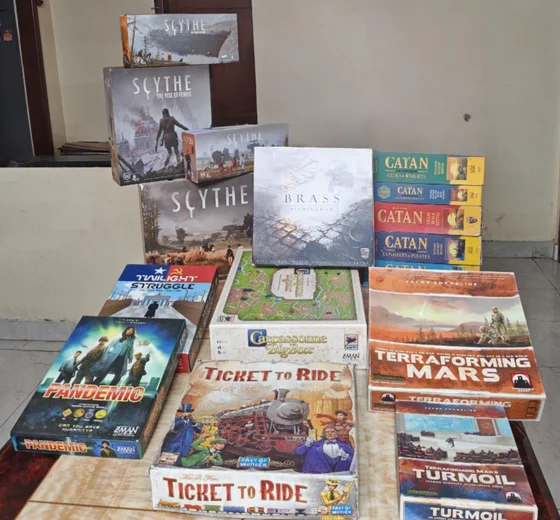
Many evenings were spent on Catan, Scythe, Terraforming Mars etc. Our home was usually noisy with lots of laughter and of course some fights as well!
But whenever we were not playing a board game, there was a very good chance you would find the three of us playing some real-time strategy or turn-based strategy game like Age of Empires, StarCraft and Civilization. I had always loved them. My boys did too. My wife, however, had a very different opinion. Looking back, I’m very glad she did.
So, we decided to take up the challenge.
Some time back, we had tried our hand at making a card based StarCraft-like game, inspired by the mechanics in “Hearthstone”, but did not pursue it seriously. At that time, since we were playing a lot of empire building games, we thought, why not make a board game around building a civilization?!
Only one problem 🙂
There were already so many civilization games out there. Did we really need to make another one?
Civilization games had been around for decades, and some great games had already explored the theme in many different ways. Building cities, developing economies, discovering technologies, constructing Wonders, expanding across maps and, of course, going to war.
If we were going to make one ourselves, I didn’t want us to simply recreate something that already existed. I wanted to understand what we enjoyed most about these games, and whether there was an unexplored angle worth pursuing.
For me, a lot of it came down to the feeling of progress.
I have certainly enjoyed the conquest side of civilization games. There is a particular satisfaction in reaching a point where you have a technologically superior army and can easily overwhelm an opponent who hasn’t kept up. But when I thought about the parts I enjoyed most, I kept coming back to increasing production, building and advancing.
Back in the days, I played a lot of Civilization III, a turn-based game where you grow a civilization from a single settler into an empire, one research and one building at a time.
In that, I used to scout a lot in the early game. Probably more than what was sensible. The reason was simple. If you happened to stumble upon a village, there was a chance they may “teach” you a technology for free. Early in the game, that could save you a lot of turns! With this strategy, by the midgame, I was usually the most scientifically advanced civilization on the map. Once I got there, everything moved faster - buildings, production, Wonders - whatever I was chasing next.
I realised then that this was probably the part I enjoyed most. Every turn leaving you a little more capable than the one before. I later learnt that, in board games, this is referred to as engine building.
And then it clicked. Engine building should be the main focus of our game.
In many civilization games, building your engine involves several interconnected systems. To build an engine, you need resources. Resources are usually found on a shared map. To obtain those resources, you need to control territory. To control territory, you may need an army. And to make all of this work, you spend time moving workers, units and armies around the map. Alongside all this, of course, you are also constructing buildings and researching technologies.
Moving units, armies, attacking a player, defending your borders can all contribute to engine building, but there were several steps between those decisions and the engine actually becoming more capable. Whereas researching a technological advancement or constructing a building felt much closer to the engine itself - you made the decision, your civilization improved immediately, visibly.
Did a civilization game need a shared map at all?
We began asking ourselves how we could make the game much closer to that core engine-building loop.
That was when we started questioning one of the most fundamental concepts:
Did a civilization game really need a shared map at all?
While that brought us some clarity, it introduced a fairly obvious hole right in the middle of the game: if the main game board was not a shared map, what should it be?
And then we wondered…
What if it was the technology tree itself?
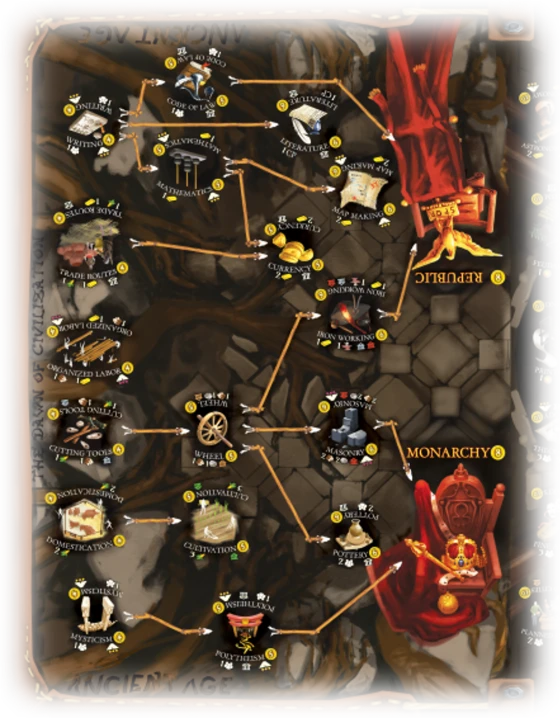
The technologies wouldn’t be in a deck of cards waiting to be drawn. They wouldn’t appear randomly during the game or rotate through a market. The research possibilities would already be there in front of you, laid out with all their dependencies visible. You could see where your civilization is, where you would like it to be and the exact research path to get there.
In INCEPTUM: Dawn of Civilizations, since everything’s already laid out, the question isn’t about the next card anymore. It’s more of where do I want to end up, and why? And, perhaps more importantly: when?
A small example from the Technology Board
In the finished game, six advancements are open to you at the very start. All of them look perfectly reasonable on your first turn. Let’s look at two of them.
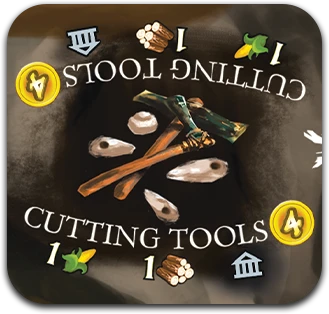
‘Cutting Tools’ increases your per-turn production of Food and Wood, and it unlocks Stone. Until you research it, your civilization cannot produce or use Stone at all, which quietly closes off a large part of what you will eventually want to build.
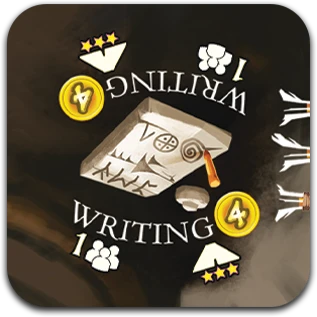
‘Writing’ does something completely different. It grants you a Population Token. Every building in the game needs one assigned to it. So until you research something that grants a Population, you cannot build any new buildings.
Neither is the wrong choice for your first turn. But whichever you take first shapes what your next few turns can look like.
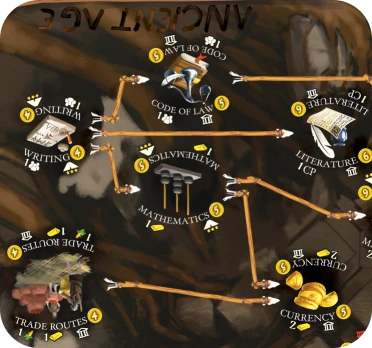
And this is before you start thinking further ahead. ‘Mathematics’ needs ‘Writing’ first. ‘Currency’ needs both ‘Trade Routes’ and ‘Mathematics’. So if Currency is where you eventually want to be, that decision is already shaping what you research on turn one, several turns before you’ll actually use it.
You might want to research an advancement because of the production it gives you. Or because it unlocks a Building or a Wonder. Or simply because it is the route to something else that you really want. But it takes resources and time, so perhaps you don’t research it yet. Perhaps you build your economy first. Perhaps you take a longer route because the technologies along the way are more useful to the civilization you are building.
That was the shift. The Technology Board stopped being a place where players just marked what they’d researched, and became the place where these decisions actually got made.
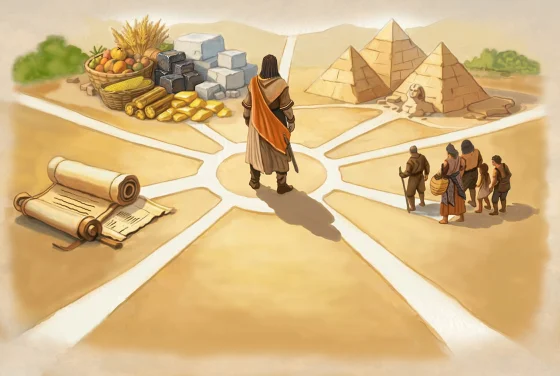
What do I invest in now?
What am I building towards?
What am I willing to delay?
Which path through the Technology Board makes sense for the civilization I am building? And when another player threatens something I was planning for, do I stay the course or change direction?
Those questions eventually became much of what INCEPTUM is about today.
The path you take through the Technology Board will shape the city you are building in front of you, and this path will be unique to you.
If the Technology Board is fully visible, where does the tension come from?
There was an interesting consequence to putting the whole Technology Board in front of everyone.
But it isn’t just the board that’s visible. All your moves are too.
Every Research Action you take, every Building you construct, tells the rest of the table something about the strategy you’re pursuing. That reveals the key pieces you’re chasing to pull it off: a Wonder, a specific Government Extra Benefit. Anyone paying attention can see it coming.
And once they can see it, they can go after the same thing. Wonders, in INCEPTUM: Dawn of Civilizations, in addition to being exclusive and yielding a lot of Civilization Points, provide unique benefits which may form a core part of your strategy. Government Extra Benefits are also exclusive. Once someone claims one, it’s gone for everybody else. So the transparency of your moves imposes a real cost. The clearer your plan, the easier you are to race, or to block outright.
That’s where the tension actually comes from.
Building the Civilization became the game
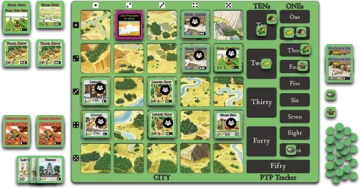
Once the Technology Board became central, the other parts of INCEPTUM naturally grew around it. Each player would have their own City Board. Research would increase production and unlock Buildings.
Constructing and upgrading those Buildings would increase production further. Population would grow to support the expanding city. The engine-building loop we had been looking for was taking shape.
But having the entire Technology Board laid out from the beginning raised another question.
If it’s exactly the same Technology Board each game, won’t players eventually figure out the best opening?
In short, no.
Different Civilizational Traits and Humble Beginnings Cards mean players rarely approach the Technology Board from the same starting point in each game. Each civilization begins with its own strengths, resources and early opportunities, so the priorities on the Technology Board can look quite different from one player to the next. Since those combinations get reshuffled in every game, the opening situation for the whole table changes as well.
This is a big enough topic on its own and worth its own post.
The game begins with civilizations that can do relatively little. Through research and construction, they gradually become capable of much more. The decisions made early in that process continue to affect what becomes possible later.
There were still plenty of things we hadn’t worked out at this stage of the design. In fact, one of them would turn into a much bigger question than we expected.
Our early versions still had armies.
They still had Barracks.
And civilizations could still attack each other.
None of that made it into the final game. INCEPTUM has no combat. What happened in between came out of playtesting, and it’s a story for another post 😊.
Join the waitlist
Pre-orders open on August 15. Leave your email and we’ll let you know the moment they do.
More design notes are coming. Follow along on Instagram: @stratmechstudios (the studio) · @prabu_amb (Prabu, Lead Game Designer) · @veena_gowrisankar (Veena, Graphic Designer & Illustrator)